


Assessment
Assessment at Holy Trinity
At Holy Trinity Church of England Primary Academy, assessment is an integral part of high-quality teaching. It helps us understand what pupils know, remember and can do, so that teaching can respond quickly, confidence can be built and strong progress secured for every child.
Our approach is shaped by our curriculum drivers of Windows, Mirrors and Doors—and these same drivers also act as drivers for assessment:
Windows, Mirrors and Doors in assessment
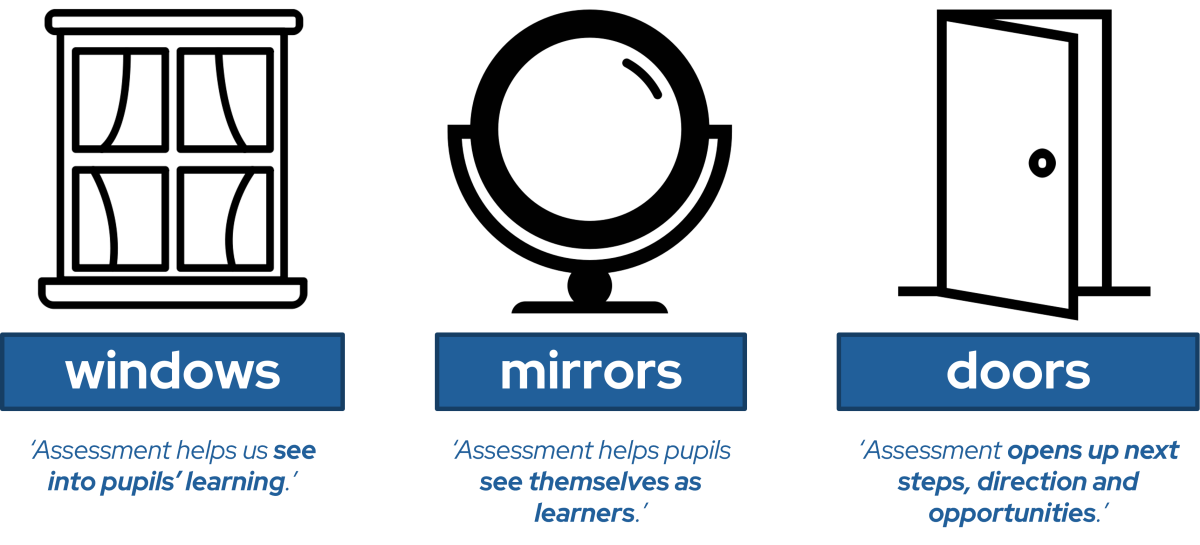
Windows: seeing into pupils’ learning
Formative assessment is a window when it reveals what’s happening beneath the surface: misconceptions, partial understanding, confidence, language barriers, gaps in prior knowledge and which pupils may be coasting.
What this looks like in practice:
- Hinge questions mid-lesson to expose misconceptions (not just “who’s finished?”)
- Cold call / no hands to sample the whole room, not just the confident few
- Mini-whiteboards / quick polls so teachers can see everyone’s thinking at once
- Exit tickets designed around the hard bit of the learning objective
- Error analysis (“spot the mistake, explain why”) to reveal conceptual understanding.
Key idea: Windows assessment is primarily for teacher insight—so teaching can be responsive.
Mirrors: helping pupils see themselves as learners
Mirrors assessment builds pupil self-awareness: What do I understand? Where am I stuck? What strategy helps me? It makes learning visible to the child, not just the adult.
What this looks like in practice
- clear models of success (examples and non-examples)
- self-assessment supported by modelling and comparison
- peer feedback routines with a tight focus (one criterion at a time)
- metacognitive prompts: “What did you try first?” “What will you try next?”
Key idea: Mirrors assessment is about pupil agency—children become better judges of quality and next steps.
Doors: opening next steps, direction and opportunities
Doors assessment is the “so what?”—the information gathered leads to action: adaptation, scaffolding, stretching, re-teaching or targeted practice, so more pupils succeed and go further.
What this looks like in practice
- responsive teaching moves in the moment (stop and re-teach, change examples, address a misconception publicly, split into guided groups)
- next-step feedback that is actionable (one improvement action, not a paragraph)
- immediate keep-up/catch-up (same day/next day)
- challenge pathways (“prove it / vary it / apply it”) for pupils who are secure
- adaptive scaffolds (sentence stems, worked examples, manipulatives) that fade out over time.
Key idea: Doors assessment is about equity and aspiration—every child gets what they need to move forward.
Why we assess
Assessment at Holy Trinity is used to:
- check understanding regularly so teaching can respond immediately
- identify misconceptions early and address them precisely
- support pupils to reflect on learning and recognise improvement
- ensure all pupils make progress from their individual starting points
- provide clear information to parents about progress and attainment, at regular points across the year.
Types of assessment we use:
Ipsative assessment (personal progress)
We use ipsative assessment to help pupils measure progress against their own starting points.
Examples include
- Cold and hot tasks in writing: pupils complete an initial independent task (cold), receive teaching and feedback, then complete a second task (hot) to show what has improved.
- Pre and Post Assessment (start and end of unit)
- “Then vs now” comparisons in maths methods and accuracy.
- redrafting and improvement in the wider curriculum.
This supports confidence, motivation and a strong learning identity.
Diagnostic assessment
Diagnostic assessment helps staff pinpoint exactly what pupils understand and what is getting in the way.
A key diagnostic strategy at Holy Trinity is the use of hinge questions:
- often multiple choice
- designed around common misconceptions
- used to determine next steps immediately
Formative assessment
Formative assessment happens continuously through teaching and learning. It includes:
- questioning and discussion
- observation during independent practice
- mini-whiteboards and exit tickets
- live feedback from teachers and teaching assistants
- quick checks that identify misconceptions early
Assessment in lessons
Assessment is built into lesson design rather than added on afterwards. Our lesson structure supports checking for understanding and clear next steps.
Typical lesson structure
- Set the scene: revisit prior learning, share the learning objective, explain success, explicitly teach vocabulary
- Direct instruction: I do / We do / You do
- Hinge question: diagnostic check that determines next steps
- Independent practice: supported by adults, models and scaffolds
- Plenary: revise, summarise, apply, address misconceptions
Marking and feedback (Whole-Class Feedback)
Our principle
“The main purpose of feedback is to improve the pupil and not simply the work.” – Dylan William
At Holy Trinity, we prioritise feedback that is timely, frequent and acted upon. Written marking is not the main driver of improvement; instead, feedback is planned as part of teaching so pupils have time to respond and improve.
Whole-Class Feedback: our main approach
Rather than writing lengthy comments in every book, teachers use a whole-class feedback approach which:
- identifies common strengths and exemplars
- pinpoints common misconceptions, spelling and technical errors
- leads to direct instruction in the next lesson
- ensures pupils act on feedback and improve their thinking and learning
Five principles we follow:
- Read through children’s work (all books where possible; sample when appropriate)
- Note strengths and select exemplars
- Note areas for improvement (misconceptions, SPaG, technical errors)
- Give the feedback (often on the IWB/visualiser)
- Provide time for improvement (so pupils act immediately)
Feedback as actions (a “recipe for future action”)
Whole-class feedback is most effective when it moves from comment to action. We use five main feedback actions:
- Redraft / Re-do (improve a section by doing X, adding Y, correcting Z)
- Rehearse / Repeat (targeted practice for fluency with carefully chosen prompts)
- Revisit / Respond (complete new questions/tasks informed by what the teacher has seen)
- Re-learn / Re-test (return to retrieval routines and prepare for a short check)
- Research / Record (specific reading/research with a clear output)
In-the-moment feedback
Pupils make the most gains when feedback is immediate and misconceptions are addressed at the point of learning. Teachers and teaching assistants provide in-the-moment feedback during independent practice, alongside rapid and responsive interventions where needed.
Consistency you will see in books
- Adults write in green pen; pupils respond in blue pen.
- In writing, editing is completed using pencil and editing strips (rather than coloured pen).
Frequency
- Maths: marked each lesson (including structured self-checking)
- Reading & Writing: detailed whole-class feedback at least weekly
- Foundation subjects: exit tickets are checked and misconceptions addressed as they arise.
Reporting progress and attainment to parents
Half-termly report cards
At Holy Trinity, children’s progress and attainment are reported to parents through half-termly report cards. This ensures information is regular, timely and focused on what matters most right now.
Half-termly report cards are designed to be clear and practical, helping families understand:
- what their child is doing well
- what they are working towards next
- how they can support learning at home
What the half-termly report card includes
Each report card provides an overview of:
- Attendance and punctuality
- Learning behaviours (e.g., focus, resilience, independence)
- Reading
- Writing
- Mathematics
- Progress
- Attainment
Judgements are informed by classroom evidence, checks for understanding, end-of-unit assessments and teacher professional judgement.
How we use assessment information
Assessment information is used by teachers and leaders to:
- support consistent teacher judgements through shared expectations and moderation
- adapt lesson sequences and curriculum planning
- identify pupils needing keep-up/catch-up or further challenge
- plan targeted support and interventions
Summative assessment
Summative assessment provides a snapshot of what has been learned and remembered after teaching. This includes:
- end-of-unit assessments (across subjects)
- periodic checks that support teacher judgement and future planning
- Use of standardised tests – NfER
No single assessment is used in isolation; summative outcomes are always viewed alongside day-to-day evidence.
Statutory Assessments
Alongside our day-to-day assessment, pupils also take part in national statutory assessments at key points during their primary education. These assessments provide useful information about attainment and help schools understand how well pupils are progressing compared to national expectations.
At Holy Trinity, statutory assessments are always viewed alongside teacher knowledge of the child and classroom learning over time. They are one part of the wider picture of a child’s development.
Reception — Reception Baseline Assessment (RBA)
The Reception Baseline Assessment takes place within the first six weeks of children starting school in Reception.
It is a short, practical and interactive assessment focusing on early:
- communication and language
- literacy
- mathematics
The activities are delivered one-to-one with the class teacher in a calm and supportive way, using familiar resources and age-appropriate materials.
The purpose of the assessment is to provide a helpful starting point, allowing staff to understand what children already know and can do when they begin school. This information supports teachers to plan learning that meets each child’s needs from the outset.
Year 1 — Phonics Screening Check
Children in Year 1 take part in the Phonics Screening Check each June.
The check consists of 40 words and usually takes between 5 and 10 minutes to complete. Some words are real words and others are pseudo (or “alien”) words. These unfamiliar words help teachers assess whether pupils can apply their phonics knowledge to decode words they have not seen before.
The check helps us identify how securely pupils are developing early reading skills and whether any additional support is needed.
If a child does not meet the expected standard in Year 1, they will have another opportunity to take the check in Year 2.
Year 4 — Multiplication Tables Check (MTC)
Children in Year 4 complete the Multiplication Tables Check in June.
This is an online check designed to assess how fluently pupils can recall multiplication facts up to 12 × 12. Secure recall of times tables is essential for success in mathematics as pupils move through Key Stage 2 and beyond.
The check consists of 25 questions, with six seconds allowed for each answer, and usually takes no more than five minutes to complete. Pupils complete practice questions beforehand to ensure they are familiar with the format.
Year 6 — National Curriculum Tests (SATs)
At the end of Key Stage 2, pupils in Year 6 complete statutory assessments in:
English Reading
(comprehension texts and questions)
English Grammar, Punctuation and Spelling
- Paper 1: short answer questions
- Paper 2: spelling
Mathematics
- Paper 1: arithmetic
- Paper 2: reasoning
- Paper 3: reasoning
In addition to these tests, teachers submit statutory teacher assessments to the local authority. These are based on a broad range of evidence collected over time, including pupils’ classwork, discussions, independent writing and practical learning.
Writing and Science are assessed through teacher judgement rather than a single test, ensuring that outcomes reflect pupils’ performance across the year.